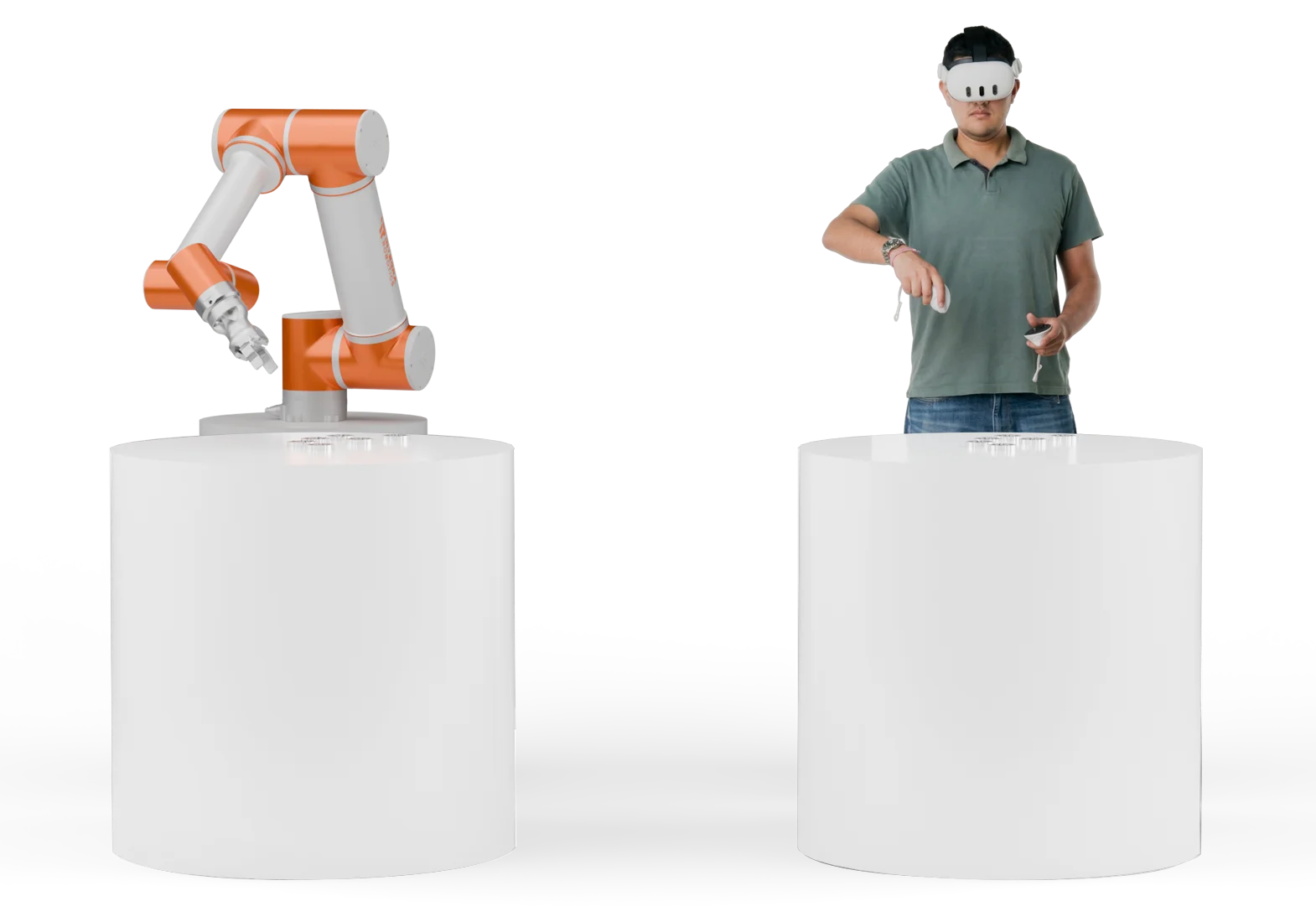
Your robots. Your operations. Your demonstration data. Independent, software-only teleoperation for robotic arms, bimanual systems and humanoid manipulation — licensed for 1 user and 2 robotic arms on Windows, Linux and Linux ARM64 with an Android interface.
Granted Indian Patent
IN597459 B1
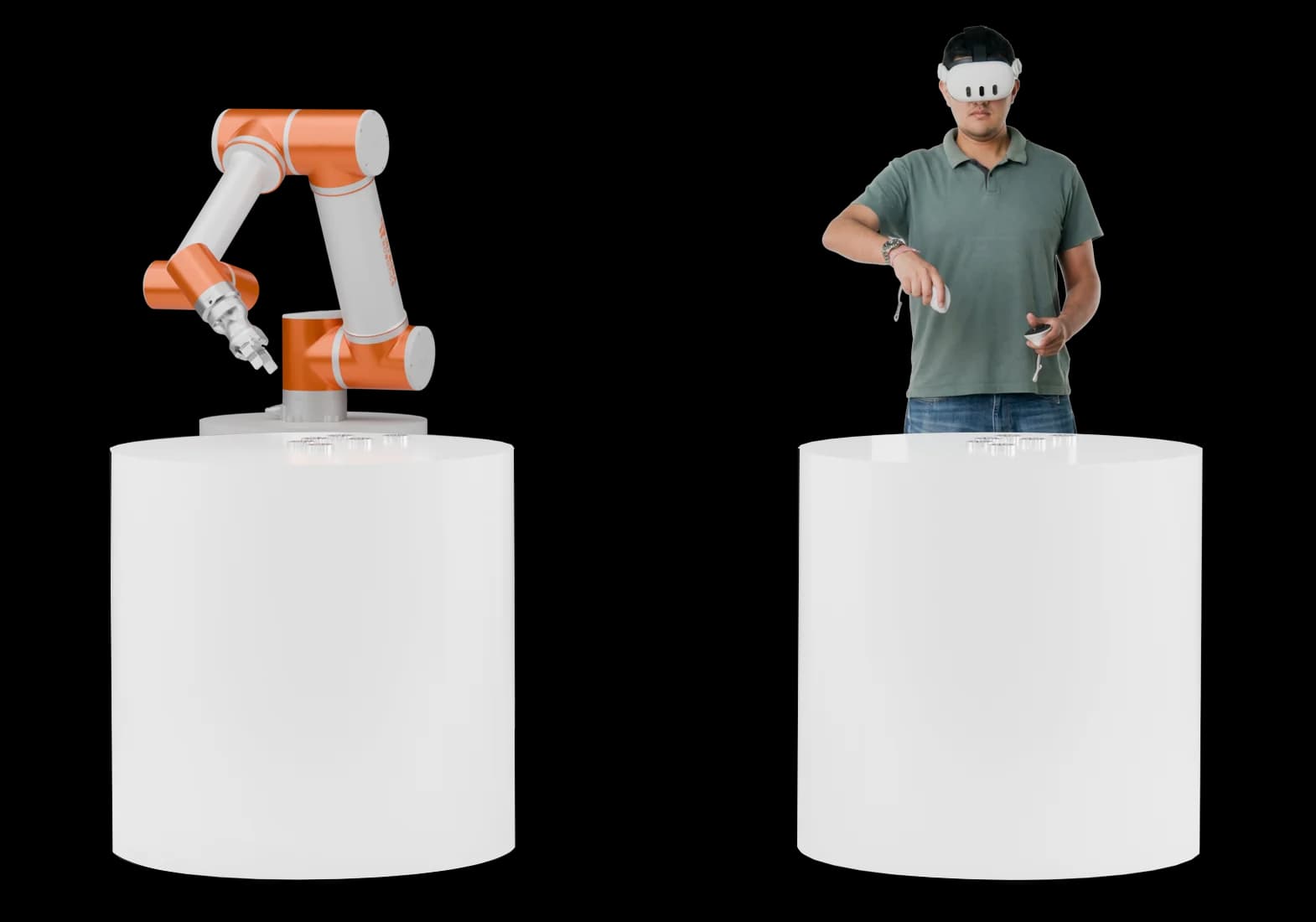
TECHNICAL SPECIFICATIONS
Software-only tele-operation licensing for robotic arms, bimanual systems and humanoid manipulation. Your robots. Your operations. Your demonstration data.
Licence Scope
1 user and 2 robotic arms · client-hosted Tele-op SDK
Supported Interfaces
Windows, Linux, Linux ARM64 and Android
HMD Application + SDK
Operator interface and robot-control endpoints
Multi-Arm Control
Synchronized manipulation and recorded motions
Operator Inputs
HMD controllers, bare-hand tracking or compatible gloves map operator intent to robot motion · secondary operator inputs
View Modes
Pass-through / MR: physical scene with a robot-state or digital-twin overlay · Camera / VR: live robot viewpoint with feedback in the HMD
Visual Feedback
Live RGB / stereo inputs and VR feedback visualization
Feedback Inputs
Robot state, sensor streams, force / torque, contact, haptics and collision proximity*
Capture Outputs
Commands, trajectories, labels, logs and recordings
Quality Labels
Operator ratings and task-outcome annotations
Robot Integration
Solved joint commands over UDP / TCP · controller-specific adapters and firmware checks define each robot connection
I/O Integration
Digital / analog I/O in the operator interface · Modbus TCP for soft I/O · CAN / EtherCAT gateways where supported
Wired Controller Control
~50 ms (indicative)¹
Hand Tracking / Non-Line-of-Sight
~100 ms (indicative)¹
Same-Network Teleoperation
50–80 ms (target)²
Local Execution
240 Hz (target)²
Safety
Local limits and emergency stop remain independent of WebRTC
Export Options
MP4 video, Parquet time series and JSON metadata, subject to integration
Standards
ISO 9001 Quality management · ISO 10218 Robot safety · ISO 13850 Emergency-stop functions · ISO/IEC 27001 Information security · ISO 31000 Risk management · ISO/IEC 17025 Laboratory competence
Patent
Granted Indian Patent IN597459 B1 · Immersive robot control, VR / MR / AR + gesture operation
Program
NVIDIA Inception Program
*Feedback availability depends on connected sensors, robot interfaces and operator hardware. 6DoF and finger tracking depend on the selected input hardware; point-cloud display requires a compatible depth pipeline.
¹Indicative latency varies with the configuration. ²Targets require validation on the selected setup. Command and video latency are measured separately.
macOS and iOS are not supported. Client supplies hardware and network. Robot / humanoid compatibility and custom integration require a separate scope. Applicable standards follow the certificate scope.
YOUR CAPTURE WORKFLOW
Client-generated training data. Capture rare conditions, failed attempts and recoveries — vary objects, lighting and viewpoints to build unique training and evaluation datasets.
HMD intent, mode and frame. Live video and robot feedback in the headset.
Constrain IK / trajectories. Log requested and applied actions.
Align video, actions and state. Label attempts, errors and recoveries.
Check sync, gaps and labels. Release accepted episodes.
DATA CAPTURE & SUPPLY ARCHITECTURE
Autonomous deployments capture repeated, fixed industrial cycles with very low expected error. Teleoperation captures human-driven attempts, errors, corrections and recoveries. Each stream has its own recording, episode preparation, QC and release.
Stream A
Stream B
Configure each setup's robot, tooling, cameras and task envelope. Authorise recording and sharing per site and operator; otherwise data stays local.
240 Hz local execution and 50–80 ms same-network latency are targets verified on your setup. Command and video latency are measured separately; local safety remains independent of WebRTC.
Device clocks are synchronised within each stream. Source, receive and application times, sequence IDs and alignment error are logged, with separate datasets, provenance, QC and hour reports.
DATASET SPECIFICATION & ACCEPTANCE
Each episode preserves an observation, the action applied over a defined interval, and the resulting state. Collection plans vary objects, fixtures, lighting and viewpoints, and include failed attempts, interventions and recovery.
Source timestamps · raw rates and sequence IDs
Clock alignment and segmentation · task phases and outcomes
Replay, schema and consent · quarantine incomplete episodes
Loader test and release manifest · training and evaluation splits
Record
Captured detail
Vision and environment
Front / wrist RGB or stereo, frame times, camera IDs and calibration. Optional depth, point clouds or audio by agreement.
Operator intent and actions
Pose / gestures, control mode and coordinate frame. Requested and applied commands, units, timestamps, sequence IDs and tracking state.
Joint and end-effector feedback
Joint position / velocity, tool pose and gripper state. Left / right arm namespaces, head or torso pose where applicable. Force, torque, contact and haptics where instrumented.
Sensors and system status
Current, temperature, faults and collision proximity where available. Source, receive and application times with alignment error.
Episode context and traceability
Task / phase, success, failure, abort and recovery labels. Session / episode IDs, schema, calibration, permissions, provenance and checksums.
MP4 video, Parquet time series and JSON metadata, subject to integration. LeRobotDataset v3 compatibility requires interface validation. Native-rate records are retained and any resampling is documented.
Resolution, frame rates, clock and video-to-action alignment tolerances, permitted gaps and label coverage are agreed before scaling. Valid hours, episode counts, drop rates and QC exclusions are reported. Training, validation and test data are separated by session, object and site, with receipt and acceptance for each release.
PHYSICAL AI DATA CAPTURE
Independent teleoperation for robotic arms, bimanual systems and humanoid manipulation. If your team needs expert demonstrations with real task variation, contact dynamics and recovery behaviour — captured on the robots you already run — the Tele-op SDK was built for you.